
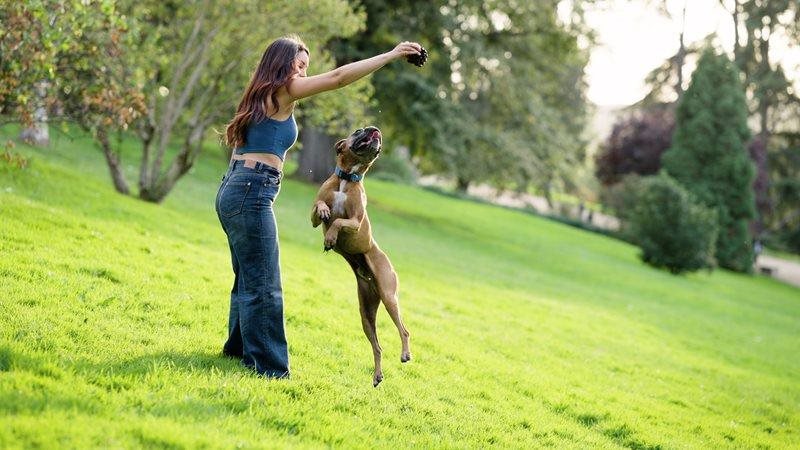
Oof. That’s the sound of air rushing out of my lungs when I get jumped on by a big dog greeting me in the clinic. I don’t mind, because the waiting room is an exciting place to be for many of my canine patients.
Another person might be scared about being knocked down, feel attacked, or just consider the dog to be pretty rude. As the pet owner, you may be embarrassed about how it looks when your dog jumps up on family, friends and strangers. You might even be worried about what your dog will do when they jump up. Let’s look at why some dogs jump up and how we can create skills that minimize undesirable behaviour.
Why do dogs jump up on people?
Understanding motivation for any behaviour is very important!
-
Hello! Love me! Feed me! Puppies lick at their mother’s mouth to stimulate regurgitation as the pups transition from nursing to eating solid food. In older puppies and adult dogs, this jumping and licking means, “We can be friends!”.
-
Let’s play! The dog doesn’t know any better – and it’s fun to jump up as an invitation to play. Puppy parents can teach skills that promote impulse control and offer an alternative behaviour that is just as rewarding.
-
Hey! I’m here! Dogs become frustrated when they’re not getting the attention they want and may resort to jumping to demand engagement. Don’t ignore this behaviour, especially in puppies. They may need to go outdoors to eliminate, express their hunger, or tell you they’re tired. Our dog, Tari, jumps up on us and grabs shoes when she needs to poop.
-
Get away now! Nervous and anxious dogs may jump up to create space from others. The face licking we discussed above can morph into snapping and biting if fearful dogs do not get that extra space immediately. This behaviour can be observed between dogs and children, and the parent may say, “Fluffy was kissing my toddler only a second ago. There were no warning signs!”
How do we stop dogs from jumping on people?
Here are a few skills I teach to help keep your pet’s four paws on the ground.
-
Impulse control and the focus hand. Dogs can’t listen when they are over-excited or overwhelmed. I teach dogs to focus on my closed hand, initially full of tasty treats, and positioned right in front of their nose. As soon as the dog looks at my hand, I say, “Yep!” and give one treat. The key is to immediately flip back to the closed fist and wait for the dog’s look to my hand. Repeat five to ten times in quick succession.
If your dog jumps up, make sure your hand is still close to their nose, but otherwise – do nothing. No praise, no punishment, period. If your dog is very exuberant, wear long sleeves and a garden glove to protect your hand. We want the dog to learn on their own that stillness is very rewarding!
Once your dog understands the focus game, hold your hand closed for longer periods of time. Usually, 30 seconds is long enough to go to the next step. Then practice the focus game in different rooms of the house, before mealtime, in the backyard, before going into the obedience class building, on quiet walks, and eventually on busy walks.
Note: I don’t use an eye focus game when correcting jumping behaviours, because eye contact from family and strangers may feel threatening and trigger aggression in stressed dogs.
-
Quiet sitting or waiting. Most of our dogs learn to sit in two or three days as puppies. Great first step! But… can your dog sit for any length of time without a treat? Does your dog pop up as soon as you say, “good dog!”?
Dogs don’t always learn what we want, and sometimes we must rethink our own behaviour to get the best out of our furry buddies. Using words they don’t know, offering hand signals too late, inconsistency between family members, and accidentally rewarding barking are mistakes we all make. I always say that my Labs, Romi and Tari, are the best Dr. Colleen trainers out there!
We want to teach our dogs that they can wait, with four feet on the floor and at our feet, on the opposite side of the couch, or across the room for a few seconds and eventually a minute or two away from us.
We might need to work slowly to get that first bit of duration and distance at first; once your dog understands the game, the progression will be easier. As we shape this game, we perform four to five repetitions in one place and gauge the dog’s success. We can always go back to the last step where they understood the game.
Important: To decrease the chance that your dog leaves their spot early, ALWAYS go back to the dog for their reward, whether you’re using treats, verbal praise, or petting.
-
Touch target games for controlled movement. Playing touch target games with your dog helps to teach them movement toward and away from a person. I start with treats held behind my back. Using your empty hand, swing your open palm toward your dog’s nose. Most will sniff to see if there’s a treat there. With any movement of their head toward your open hand, say, “yep!” and immediately swing your treat hand forward. Your dog will have to change their position slightly to get the treat from this hand, and that’s good. We want to see them move between your hands from touch hand to treat hand. Reset by placing your hands behind your back. Switch which hand has the treat. Eventually, you want to see a robust “nose boop” or “touch” where the dog intentionally nudges your hand. Repeat the game four or five times.
-
Two-person touch target practice. Take the touch target game to the next level. Have one family member hold out a target hand while another member holds the treat. Start close together and slowly increase the distance between you. For dogs that are not food driven, have the family member hold out a toy for the dog to take back to you. You can toss the toy as their reward and reset the game for the next repetition.
We must be consistent at this stage to ensure the dog gets NO attention for jumping. As mentioned above, we want the dog to learn that jumping does not get the response they want. No praise, no punishment, period.
-
Putting it all together. Use your focus hand to help them maintain a quiet sit or down. It’s okay to use a leash when you’re expecting company if you have practiced with the leash during the training process.
When people come into the home, wait until they are settled. Ask them to offer a target hand signal to your dog. As soon as the dog offers the nose boop, call the dog back to you for a reward from your focus hand. Repeat a few times or offer a toy toss game with the visitors.
-
Practice for the rest of your dog’s life. Dogs easily learn the skills that go along with good manners. As pet parents, it’s up to us to continue to ask them for these skills, refine the timing, and practice the skills in different situations and places. Lifelong learning is one of the best gifts you can give your dog.
-
Aggressive and anxious dogs. If your dog shows signs that they are uncomfortable or stressed when jumping up, please consult with your veterinarian for a complete behaviour modification plan.
Pet insurance can help with the cost of vet visits
We want to ensure that your dog is not jumping up because they are in pain, feeling nauseated or otherwise unwell. Petsecure can help cover the costs of veterinary care to help your pet live their longest and happiest life. Learn more about our four coverage plans and get your free quote!
Dr. Colleen Fisher obtained her Doctor of Veterinary Medicine in 1990 from the University of Saskatchewan. She is the veterinarian for the Canadian Task Force 4 (Manitoba) Urban Search and Rescue Team. Dr. Fisher received her MSc in Clinical Animal Behaviour from the University of Edinburgh in 2019. As Petline's Veterinary Medical Director, she is enthusiastic about sharing knowledge between the insurance professionals and veterinary team members that serve our mutual clients.