
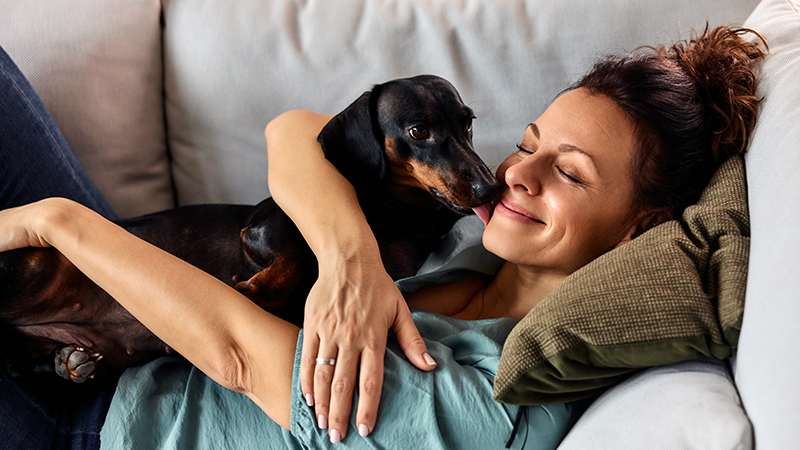
Do you love being kissed by your dog? Or do you feel dogs should keep their tongues to themselves?
Getting kissed by dogs in the clinic is an everyday part of the job for veterinarians. Luckily for me, I don’t mind it. However, I have healthy respect for the folks who prefer to keep their faces slobber free.
Alright, with that out of the way, let’s get to figuring out why your dog is always licking you. To do that, we have to talk about wolves.
Puppy Kissing
There are not many places where I compare dogs to wolves, but there is one important similarity. And this similarity gives us an important clue about why some dogs lick their owners a lot.
During weaning, both dog and wolf puppies kiss and jump at their mom’s face. This behaviour is a type of begging. They do this to stimulate a regurgitation reflex, allowing the puppy to eat semi-digested solid foods. The more puppies beg, the more attention and food they may receive.
Understanding this early “begging” behaviour in puppies helps set the stage for why adult dogs continue to use licking as a powerful communication tool with their humans.
So how does this puppy behaviour translate to adult dogs?
Why does a dog lick your face?
1. They get attention. For many dogs, they will feel rewarded by any attention, either with positive praise or verbal corrections. They may even feel like you want to play when you push them away from you.
2. They get food. Dogs love our snacks and learn quickly that they will get something off your plate if they lick your face or your hands while you’re eating. We think they will leave us alone if we give them “something.” Nope! They’ve just trained you to feed them people food when they bother us.
3. People taste good. Dogs enjoy the saltiness of our skin, certain skin lotions or the ice cream drips on our arms. Be cautious though. You shouldn’t be ingesting medicated creams or slow-release drug patches on your skin.
4. Their tummy aches settle. If your dog has acute or chronic nausea from a medical condition, they may feel relief with licking. Because you make all things better in their eyes, you might be the first place they lick.
5. Their pain or itchiness gets relief. Dogs with skin conditions or pain may lick their people to have them rub or scratch uncomfortable body parts that need attention.
6. They are looking for friends. Kissing family, friends and strangers is a way for dogs to introduce themselves in a polite way. We call this action an affiliative behaviour. It is meant to strengthen social bonds with people and other dogs.
7. They are signalling “peace.” Licking can also be an appeasement response where dogs are looking to diffuse potential social tension. They read people’s body language and tone and may worry that an unfamiliar person needs extra reinforcement to make the situation is safe.
Does licking mean the dog wants to be submissive?
This idea comes from dominance theory in dog training, which has long been debunked by scientists.
Dominance theory claimed that dogs and wolves misbehave because they’re trying to “be the alpha,” in a pack. However, this idea came from flawed studies. It’s now debunked because real wolf packs (and dogs) don’t operate through dominance struggles.
In other words, our dogs don’t want to be “the alpha.” They want to be family members.
When a dog licks someone, they are not signaling submission. They are communicating that they want to be friends, or that they are not a threat.
Here’s the challenging part though.
The kiss to dismiss
If we react “rudely” by offering direct eye contact, lowering our faces for more kisses or trying to give a hug, the dog may react with a growl, snap or bite.
These kinds of dogs are not trying to be the alpha. On the other hand, they don’t want to be subordinate either. They want to be treated with care and respect for their emotional needs.
If you notice any concerning anxious or aggressive behaviours in your dog, please contact your veterinary team for guidance about the specific situation.
Should I let my dog kiss my face?
1. Dogs keep themselves clean by licking their lips, their bums and their feet, which can all carry dirt or bacteria.
2. Dogs who eat raw diets pose a higher risk because foodborne germs like E. coli and Salmonella can be passed on to people.
3. Small children, older adults, and people with weakened immune systems should avoid facelicking from dogs to stay safe.
What can I do to stop my dog licking my face?
Once we rule out physical and emotional problems, the key to decreasing your dog’s impulse to lick faces is to teach them a replacement behaviour. We can also help anxious dogs build independence. That way, they don’t need to climb on top of you just to feel safe.
Replacement behaviours
Ask your veterinarian for a focused behaviour that involves:
- Picking up a toy with their mouth
- Searching for treats in a towel or under a box
- Chewing an appropriate object
- Performing a simple skill for a food reward
- Playing fetch
You could also try a daily play session that lasts two or three minutes. This is often long enough to redirect the dog’s unwanted attention away from kissing you. This kind of problem solving gives your dog the attention they’re looking for and builds positive feelings that aren’t tied to licking or kissing.
Promoting independence
This technique has three simple steps.
1. Use a stable chair and a slip lead or “inside” leash that is not associated with the excitement of walking.
2. Place the dog’s station-training mat, yoga mat or bathmat beside the chair and away from any furniture they might want to jump on.
3. Sit with the dog leashed beside us while we scroll on our phones, read a book or watch a movie. Whatever you do, the important part is not to communicate with them.
And that’s it!
When you do this, there is no talking to the dog, no rewards and no corrections. In fact, I recommend placing a blanket or towel over their lap in case the dog wants to jump up. That’s because we are not going to be telling them to get off. No communication at all.
We ignore the dog until they can sit or lie down for a minute or two. Over time, we want the dog to be able to sit or lie beside you (bonus points for sitting under your chair) for up to 30 minutes at a time.
Close but not too close
Try this approach and let us know how it works for you and your canine family members! If you need help with the cost of veterinary visits related to behavioural concerns, pet insurance can help.
How Petsecure can help
Learn more about our four coverage plans and get your free quote!
Dr. Colleen Fisher obtained her Doctor of Veterinary Medicine in 1990 from the University of Saskatchewan. She is the veterinarian for the Canadian Task Force 4 (Manitoba) Urban Search and Rescue Team. Dr. Fisher received her MSc in Clinical Animal Behaviour from the University of Edinburgh in 2019. As Petline's Veterinary Medical Director, she is enthusiastic about sharing knowledge between the insurance professionals and veterinary team members that serve our mutual clients.